

Why Your Indian Business is Losing Sales Without a Proper WhatsApp CRM

Leads contacted within five minutes are about nine times more likely to convert than leads contacted later, according to lead follow-up research. Now picture your Tuesday afternoon.
Your phone buzzes. An IndiaMart enquiry for 500 units. Then a TradeIndia lead. Then someone from your Facebook ad asks for a price list. Meanwhile, one rep is replying from his personal number, another is out sick, and your "master list" lives in a spreadsheet called leadsfinalv3. We've all been there.
Here's the frustrating part. Buyers are already on WhatsApp. A Vodafone Idea MSME study from 2025 found that 46.8% of Indian MSMEs use WhatsApp Business to talk to customers. The mess is behind the scenes. Businesses without any lead routing took more than 13 hours on average to reply. By then, your competitor has sent a quote.
That's where a WhatsApp CRM comes in. Think of it as one home for every lead. It captures enquiries from marketplaces, ads and forms. It gives your team a shared WhatsApp inbox. It tracks every follow-up, so nothing slips through.
The change is pretty simple. A new lead lands, gets assigned to a rep, and a reminder is set. Every chat is saved, even if that rep quits next month. No more guessing who replied to whom. Faster replies and steady follow-ups mean more closed deals, without hiring more people.
So which tool fits your business? Let's go through seven options, starting with the one built for how Indian MSMEs actually sell.
1. Lead Opal: The All-in-One Sales & Marketing Platform for Indian MSMEs
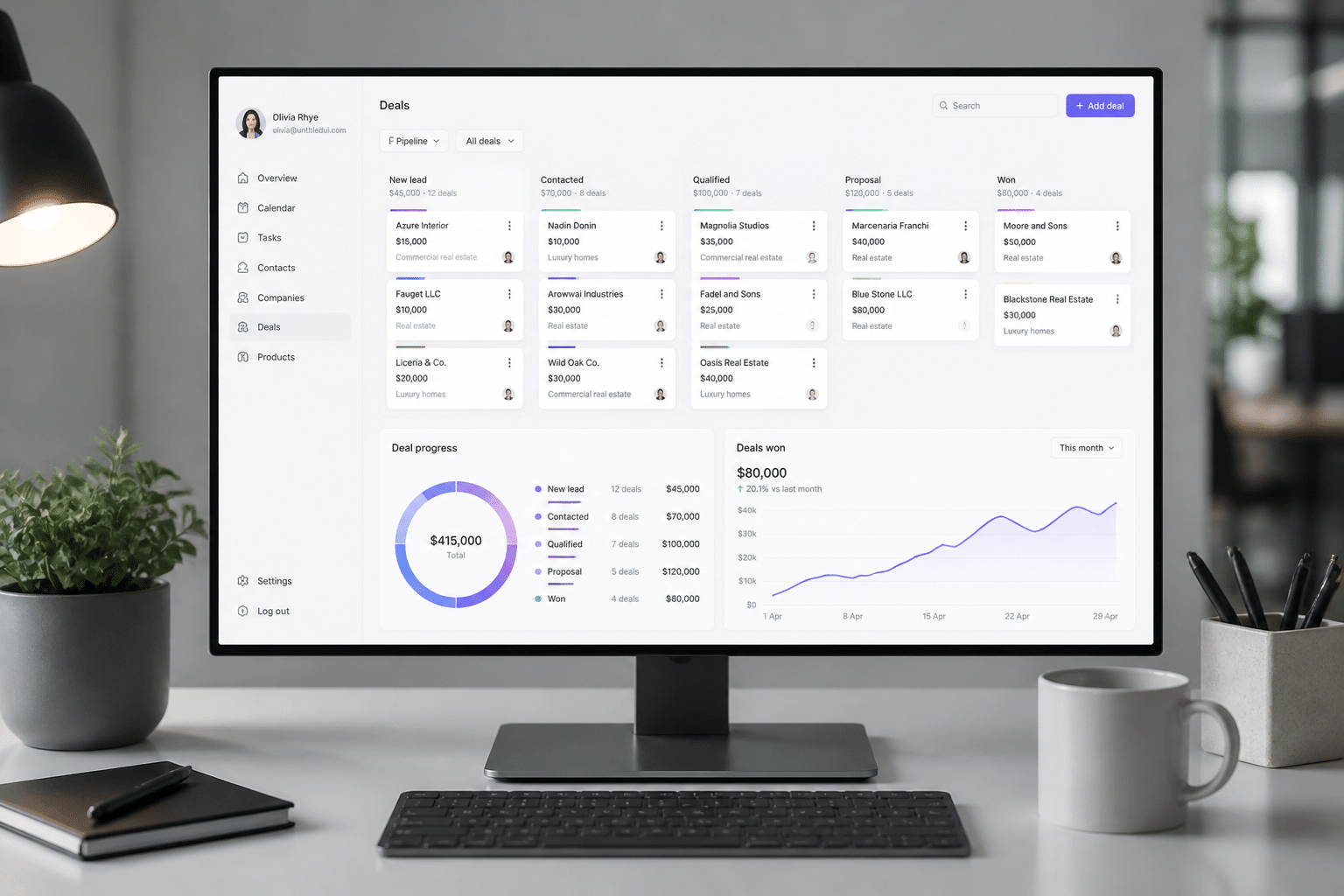
Let's start with Lead Opal, since it's built around how Indian MSMEs actually sell. If your leads come from IndiaMart, TradeIndia and JustDial, and your reps live on WhatsApp, this one was made for you. I'll be upfront: I couldn't find public 2026 pricing or a published customer case study for it, so you'll want to ask the team for a quote and a live demo.
One Pipeline for Every Lead Source
Most tools make you copy leads by hand. Lead Opal pulls them in on its own. It connects directly with IndiaMart, TradeIndia, JustDial, Google Ads and Facebook Ads. Custom webhooks and form submissions work too.
So that 500-unit enquiry from Tuesday afternoon? It lands in one pipeline, gets assigned, and gets a follow-up reminder. No retyping. No checking five dashboards.
There's also a drag-and-drop form builder. You can embed forms on your website, share a link, password-protect them, or make a QR code for trade shows and track the scans. And a drag-and-drop automation builder handles lead routing and repeat follow-ups, so you don't need a developer to set it up.
WhatsApp Shared Inbox You Can Actually Manage
Here's where it gets interesting for owners. Lead Opal includes the official WhatsApp API for broadcasts and high-volume messaging. It also has a shared inbox that covers your reps' WhatsApp numbers, both personal and API-based.
That matters because personal phones are a black box. When a rep quits, the chats leave with him. With a shared inbox, you can see who said what, check quality, and hand a conversation to someone else in seconds.
Permissions are granular and role-based. You decide which modules each person sees. A new telecaller doesn't need your invoices. Your accountant doesn't need your ad data.
Quotes, Invoices and Targets in the Same Place
OK, this part saves real time. Lead Opal has a built-in invoicing suite, so you can create quotations (with variations), sales invoices and tax invoices without opening Tally or a Word template. It supports multi-currency billing and embeds QR codes for direct payments.
Plus, you can set sales targets for each rep and look back at weekly, monthly, quarterly and yearly results. No more verbal check-ins that nobody remembers.
Here's a quick look at what's packed in:
Need | What Lead Opal offers |
Lead capture | IndiaMart, TradeIndia, JustDial, Google Ads, Facebook Ads, webhooks, forms |
Official API, shared inbox, broadcasts, segmentation | |
Other channels | Email marketing and SMS (DND-compliant) |
Automation | Drag-and-drop workflows for routing and follow-ups |
Billing | Quotations, sales and tax invoices, QR payments |
Team control | Sales targets, role-based permissions, analytics dashboards |
It's best for manufacturers, wholesalers, distributors and trading companies with a real sales team and steady inbound leads. If you only sell through Shopify, a simpler tool might do. Next up, let's look at a tool that's all about WhatsApp engagement.
2. WATI: Powerful WhatsApp Engagement & API Platform
WATI is the tool you pick when WhatsApp itself is the main event. It's built on the official WhatsApp Business API, and it's very good at chatbots and big broadcasts. But it isn't a full CRM. More on that in a minute.
Best for: Businesses needing advanced WhatsApp chatbots that already have a separate CRM.
Chatbots and Broadcasts Are Where It Shines
WATI has a no-code chatbot builder. You set up questions, replies and handoffs without writing a line of code. A bot can greet a new lead, ask which product they want, and pass the chat to a rep when things get serious.
The broadcast tools are just as strong. You can send approved template messages to thousands of contacts at once, which is handy for offers, restock alerts and payment reminders. If your team spends its day answering the same ten questions, this is a real time saver.
What It Costs and Connects To
Pricing is a mix. According to this WATI pricing breakdown, plans run roughly $69/month (Growth), $149/month (Pro) and $349/month (Business), with a set number of users included. Meta's message fees come on top.
It also plugs into HubSpot, Zoho, Salesforce and Shopify, and Zapier links it to more than 2,000 other apps. Setup is easy for simple workflows. A two-way CRM sync takes more effort.
Where It Falls Short for Indian MSMEs
Here's the catch. WATI is a WhatsApp communication tool, not a sales CRM. I couldn't find a documented native IndiaMart connector, so marketplace leads usually need a webhook or an automation tool in between. There's no built-in invoicing either, so quotes and GST bills still live in Tally or Zoho Books.
That's fine if you already have a CRM. If not, you're stitching tools together again. Let's look at a WhatsApp-first option aimed at online sellers next.
3. Interakt: Jio Haptik's Solution for WhatsApp Commerce
Interact with an online store owner for ten minutes and you'll probably hear the name Interakt. It's backed by Jio Haptik, and it's one of the most popular WhatsApp tools in India for shops that sell directly to shoppers.
Best for: Direct-to-consumer (D2C) brands and e-commerce stores running on platforms like Shopify.
Built for Online Stores
Setup is quick. Interakt offers a one-click start, and it helps you through the green tick verification process, so your business name shows up as verified on customers' phones. That small badge builds trust fast.
The product catalog tools are the real draw. You can share items right inside a chat, and shoppers can browse without leaving WhatsApp. Plus, it sends automated updates for order confirmations, shipping and payment reminders. Fewer "where is my parcel?" messages. Your support team will thank you.
Pricing and the Sales CRM Add-On
Interakt does have a sales side. According to Interakt's own Sales CRM page, it costs ₹499 per agent per month plus taxes, with a minimum of five agents. So a five-person team pays about ₹2,495/month before GST. It includes a visual pipeline with stages like "New Lead," "Quotation Sent" and "Order Confirmed," plus lead assignment and a shared WhatsApp team inbox. A 14-day free trial is listed on the site too, but check the current terms.
Where It Fits (and Where It Doesn't)
Here's my honest take. Interakt is great for B2C retail. But if you sell in bulk to other businesses, the fit gets shakier.
The pipeline is built around chats and WhatsApp commerce. I couldn't confirm a direct IndiaMart connector on its integrations page, so marketplace leads probably need a webhook or an automation tool. Complex quotations, GST invoices and deeper sales tracking usually live somewhere else. A manufacturer chasing 500-unit enquiries needs more than order alerts.
Need | Interakt |
Shopify and catalog selling | Strong |
Order and shipping updates | Strong |
Basic pipeline and shared inbox | Yes (Sales CRM add-on) |
IndiaMart lead capture | Not confirmed, likely via webhook |
GST invoicing and complex quotes | External tool likely |
Next, let's look at a tool that puts the team inbox front and center.
4. Gallabox: Collaborative Team Inbox for WhatsApp
Gallabox does one job really well. It fixes the shared WhatsApp inbox problem. If your reps are still chatting from personal numbers, this tool pulls everyone into one place.
Best for: Teams needing a simple, powerful shared inbox without a full CRM suite.
One Inbox, Many Agents
The idea is simple. Customers message one business number, and your whole team answers from a single screen. Nobody needs to share a phone or a password. When a rep goes on leave, you hand the chat to someone else in two clicks and the history stays put.
You also get smart agent routing, so new chats land with the right person. Canned responses save typing for the questions you answer fifty times a day (price, delivery time, GST details). And basic automation sends follow-up nudges so a chat doesn't go cold.
One catch. I couldn't find clear proof of a built-in rule for routing by territory or product line. You can probably set it up with tags and workflows, but ask the team before you count on it.
What It Costs
As of October 2026, Gallabox's pricing page lists the Advanced plan at ₹16,999/month on quarterly billing, with 10 users included. Pay annually and it drops to ₹13,599/month. Meta's WhatsApp message charges and taxes are usually extra.
Where It Stops
Here's the trade-off. Gallabox handles team conversations, not your whole sales process. It connects to tools like Zoho CRM, Shopify and Zapier, according to its integrations documentation. But I couldn't confirm a native IndiaMart connector, so marketplace leads likely need a webhook.
Need | Gallabox |
Shared WhatsApp inbox | Strong |
Agent routing and canned replies | Yes |
Basic follow-up automation | Yes |
IndiaMart lead capture | Not confirmed, likely via webhook |
GST invoicing and sales analytics | External tools needed |
So you'd still pair it with separate tools for leads, billing and reports. Let's look at a general-purpose CRM next.
5. Zoho Bigin/CRM: A General-Purpose CRM with WhatsApp Integration
Zoho is the name almost everyone has heard. It's a big, well-loved ecosystem, and if your accountant already uses Zoho Books, you've probably seen it around. Zoho CRM is strong on pipelines, lead ownership, tasks and reports. Bigin is its lighter, cheaper sibling for smaller teams.
Best for: Larger businesses or tech-savvy MSMEs already invested in the Zoho ecosystem.
Want to stop losing leads?
See how Lead Opal helps you capture, track, and follow up on every lead — automatically, across WhatsApp, Email & SMS.
WhatsApp Is an Add-On, Not the Core
Here's the thing. Zoho isn't a WhatsApp-first tool. WhatsApp comes in through an integration, and you can read how Zoho describes the WhatsApp setup in its own help guide. Messages show up inside lead and deal records, which is handy for context. But reps may hop between records and messaging views. A dedicated shared WhatsApp inbox usually feels faster when someone is handling thirty chats at once.
What It Costs for a 10-Person Team
Bigin looks cheap at first. Zoho's Bigin FAQ puts WhatsApp inside plans from Express upward, and Express is $7/user/month on annual billing. That's about $70/month for 10 users, or roughly ₹6,000. Meta's message fees come on top.
Zoho CRM Standard is listed at ₹800 per user per month, so about ₹8,000 for ten people. Then add-ons creep in. Third-party connectors and setup help can run another ₹2,500 to ₹8,000 a month.
The Catch for Indian MSMEs
Zoho has no out-of-the-box IndiaMart or TradeIndia connector that I could confirm. You'd set up a webhook or a custom function, map the fields, and test it. An experienced Zoho admin might finish a basic version in 4 to 8 hours. A reliable one takes longer.
And if you don't have an IT person? The customization can feel like a lot. Powerful, yes. Plug-and-play, not really.
Need | Zoho Bigin/CRM |
Pipelines and reports | Strong |
WhatsApp inside CRM records | Yes, via integration |
IndiaMart lead capture | Webhook or custom setup |
Setup effort | Medium to high |
Next, let's look at a CRM built for telesales teams.
6. TeleCRM: CRM for India's Telesales Teams
If your reps spend most of the day on the phone, TeleCRM probably fits better than the tools above. It's built around calling. Not chatting, not campaigns. Calling.
Best for: Businesses where telecalling is the primary sales activity.
Calls and Follow-Ups Come First
The dashboard centers on call logs and follow-up schedules. A rep opens it and sees who to call next, who asked for a callback at 4pm, and which leads went quiet. Managers can check agent activity and source-wise results without chasing anyone for a status update.
Lead capture is covered too. TeleCRM connects directly with IndiaMART and Facebook Lead Ads, and its IndiaMART setup tutorial walks you through it. Excel or CSV import is still there for offline lists. I couldn't find public pricing, so ask for a quote.
WhatsApp Sits Next to the Call Log
Here's the nice part. WhatsApp lives inside the same record as the calls. A rep can send a templated message after a missed call, then see the whole conversation beside the call history. TeleCRM also lists chatbots, bulk messages and drip sequences, and this 2026 WhatsApp walkthrough shows how they work.
Where It Stops
The trade-off is focus. It's heavily tuned for telecalling workflows. If most of your leads arrive from digital sources and you want advanced marketing automation, email and SMS campaigns, or built-in quotes and GST invoices, it'll feel narrower than an all-in-one platform.
Need | TeleCRM |
Call tracking and follow-up reminders | Strong |
WhatsApp templates and chat history | Yes |
IndiaMART and Facebook Ads capture | Direct integration |
Marketing automation and invoicing | Limited, external tools likely |
Next, let's look at a global option that plays in a different league.
7. HubSpot with Integration: The Enterprise-Grade Global Option
HubSpot is the big name you've probably heard at every marketing conference. It's a world-class platform, famous for inbound marketing tools and a deep CRM. If you had a huge budget and a full marketing team, it'd be a fun toy box.
But for most Indian MSMEs? Hmm. Let's talk about why.
Best for: Well-funded startups or large enterprises with a dedicated marketing team and a significant budget.
WhatsApp Isn't Built In
Here's the first catch. HubSpot doesn't give you a full WhatsApp setup out of the box. You add it through a third-party app from its marketplace. That means one more vendor, one more bill, and one more thing to keep working.
The cost depends on the app. Some charge per connected seat, others per message or per account. And the way they sync can be different too. Phone numbers saved with or without +91 can create duplicate contacts, for example. So test with real Indian customer data before you commit.
What 10 People Would Really Pay
Let's do the math. For a 10-person team, HubSpot's Sales Hub Professional runs about $900/month on annual billing, plus a required $1,500 one-time onboarding fee. Add a WhatsApp connector at around $20 per seat each month, and your first year lands near $14,700. That's roughly ₹12 to 13 lakh before GST and WhatsApp message fees.
Cost item | Estimate |
Sales Hub Professional (10 seats, annual) | $10,800 |
Required onboarding | $1,500 |
WhatsApp connector (about $20/seat/month) | $2,400 |
First-year total | About $14,700 |
That's a lot for a team that just wants to answer enquiries faster.
The India Gap
HubSpot is a generic CRM. GST invoicing needs a separate tool like Zoho Books or Tally. IndiaMart and TradeIndia leads need a webhook or an automation platform like Zapier. None of this is impossible. It just takes time, money, and someone who knows how to set it up.
So here's my honest take. HubSpot is powerful, but it's usually overkill and too pricey for a typical MSME. If you want something built for how you already sell, there's a simpler path. Let's look at one more option before we compare them all.
Quick Comparison: Which WhatsApp CRM is Right for Your Business?

Seven tools is a lot to hold in your head. So here's a cheat sheet. This table pulls the biggest deciding factors for a WhatsApp CRM in India into one view, so you can scan it in a minute and cross off what doesn't fit.
If IndiaMart crm integration and GST billing matter to you, look at those two columns first. They're where most tools split apart.
Tool | Official API | Shared Inbox | IndiaMart/TradeIndia Integration | Built-in Invoicing | Automation Builder | Price Point |
Lead Opal | ✓ | ✓ | ✓ (direct) | ✓ | ✓ (drag-and-drop) | Ask for quote |
WATI | ✓ | ✓ | ✗* | ✗ | ✓ (no-code chatbots) | $$ |
Interakt | ✓ | ✓ (Sales CRM add-on) | ✗* | ◐ | ✓ | $ |
Gallabox | ✓ | ✓ | ✗* | ✗ | ◐ | $$ |
Zoho Bigin/CRM | ✓ (via integration) | ◐ | ✗* | ✗ (Zoho Books separate) | ✓ | $$ |
TeleCRM | ✓ | ◐ | ✓ (direct) | ✗ | ◐ | Ask for quote |
HubSpot + app | ✓ (paid app) | ◐ | ✗* | ✗ | ✓ | $$$ |
How to read it:
✓ means yes, ✗ means no, ◐ means partial or limited.
* means we couldn't confirm a native connector, so expect a webhook or an automation tool in between.
$ is under ₹5,000/month for a small team, $$ is roughly ₹5,000 to ₹20,000, and $$$ is above that. Meta's message fees are extra everywhere.
Prices change, so recheck before you buy. Next, let's turn this table into a simple way to pick.
How to Choose the Best WhatsApp CRM for Your Indian MSME
Seven tools. One decision. Before you sign up for any trial, grab a pen. Five minutes of honest answers can save you weeks of regret (and a few thousand rupees).
Ask Yourself These Questions First
There's no single winner for everyone. The best WhatsApp CRM is the one that fits how your team actually sells. Here's a quick self-check:
- Where do most of your leads come from? IndiaMart, TradeIndia, JustDial, ads, or walk-ins? If it's marketplaces, check for a direct connector before anything else.
- Is built-in invoicing a must-have? If your team still makes GST quotes in Word, the answer is probably yes.
- How important is monitoring your team's WhatsApp chats? If reps use personal numbers today, you need a shared WhatsApp inbox that covers them.
- How many people will log in? Per-seat prices add up fast.
- Who sets it up? No IT person? Skip anything that needs webhooks and custom mapping.
If you answered "marketplaces, yes, very, ten people, nobody," your shortlist just got shorter.
All-in-One or a Pile of Separate Tools?
Stitching tools together feels cheaper at first. A CRM here, a broadcaster there, Tally for bills. But every extra tool brings another login, another bill, and another place where data can go wrong.
One 2026 analysis says sales teams lose around 12 hours a week chasing information stuck in separate systems. It isn't India-specific, but it sounds painfully familiar, doesn't it?
There's also setup time. Custom-built integrations are commonly estimated at 3 to 6 months for a basic system. A ready-made all-in-one platform usually goes live in a few weeks, though that depends on WhatsApp API approval and how messy your data is.
Then there's data integrity. When leads, chats and invoices sit in one place, nobody has to retype a phone number. And when a rep quits, the history stays.
Pick Something Built for India
Global tools are good. But they weren't made for your day-to-day. Look for:
GST-ready quotes and invoices, so you're not exporting to another app.
DND-compliant SMS, so a campaign doesn't land you in trouble.
Direct IndiaMart and TradeIndia connectors, not "we'll figure out a webhook later."
UPI, QR and local payment options for collecting money faster.
If a vendor says "yes, we integrate," ask to see it working with your own lead data. Seriously, ask.
Got your answers? Next, let's pull this together so you can move forward.
Stop Juggling Tools: Unify Your Sales with the Right WhatsApp CRM

Here's the plain truth. A WhatsApp CRM isn't a nice extra anymore. For an Indian MSME, it's closer to a survival tool. Buyers already chat on WhatsApp, your competitors reply fast, and a lead that waits too long just walks away.
Let's boil it down to three wins:
Less lead leakage. Every enquiry from IndiaMart, TradeIndia, JustDial or your ads lands in one place, gets an owner, and gets a reminder.
Real accountability. You can see who replied, who didn't, and who's hitting targets. No more guessing from verbal updates.
Professional communication. Chats happen on official, trackable channels, not on someone's personal phone that walks out the door with them.
And the tool itself? It doesn't have to be fancy. Maybe your team lives on the phone, so TeleCRM fits. Maybe you run a Shopify store, so Interakt makes sense. Fair enough. But if your day is marketplace leads, WhatsApp chats and GST quotes all tangled together, an all-in-one, India-focused platform like Lead Opal saves you from paying for (and babysitting) five separate tools.
So here's my advice. Pick two tools. Run a trial with your own real leads, not a demo script. Ask each vendor to show your IndiaMart enquiry flowing through. Then trust what you see.
One rep, one missed message, one lost order. It adds up fast. Why let it?
Ready to see it in action? Book a demo of Lead Opal and watch your own leads, chats and quotes come together in one place.