

Introduction: Why Your Next Lead from IndiaMart Could Be Lost in Minutes

Picture this. It's 11:40 on a Tuesday morning, and your phone buzzes with a new IndiaMart enquiry. A buyer in Pune wants 500 units of your industrial valves. Real money. Real interest.
Your sales rep is on another call. Then he's at lunch. By the time he opens the enquiry at 2:15, the buyer has already spoken to two of your competitors. One of them even sent a price on WhatsApp. Your lead? Gone.
Sound familiar? I've seen this play out more times than I'd like to admit.
The Five Minute Problem
Here's the thing about speed. Lead response research from MIT and InsideSales (covering about 15,000 leads) found that reaching out within five minutes made a lead roughly 21 times more likely to qualify than waiting 30 minutes. I can't tell you the exact drop for every single minute, and nobody honestly can. But the pattern is clear. Wait, and the lead cools off fast.
And for Indian MSMEs, the problem runs deeper than slow replies. Leads come from IndiaMart, a website form, ad campaigns, and phone calls. Some sit in a spreadsheet. Some live on a rep's personal phone. Some get forgotten completely. Plus, there's the pile of junk and duplicate enquiries that eats everyone's time.
So you're paying for leads, then losing them to slow, manual follow-up. Painful.
What Changes With an SMS CRM
Now imagine a different Tuesday. The enquiry lands, and within seconds the buyer gets a friendly text with your name and a next step. The lead is assigned to a rep automatically. A reminder is set. Nothing slips through.
That's what an SMS CRM does. It captures leads from sources like IndiaMart, replies instantly, and keeps every follow-up on track. It turns a reactive, "we'll get to it" process into a proactive sales engine.
Let's look at what that actually means, and why it's more than just sending bulk texts.
What is an SMS CRM? (And Why It's More Than Just a Bulk SMS Tool)
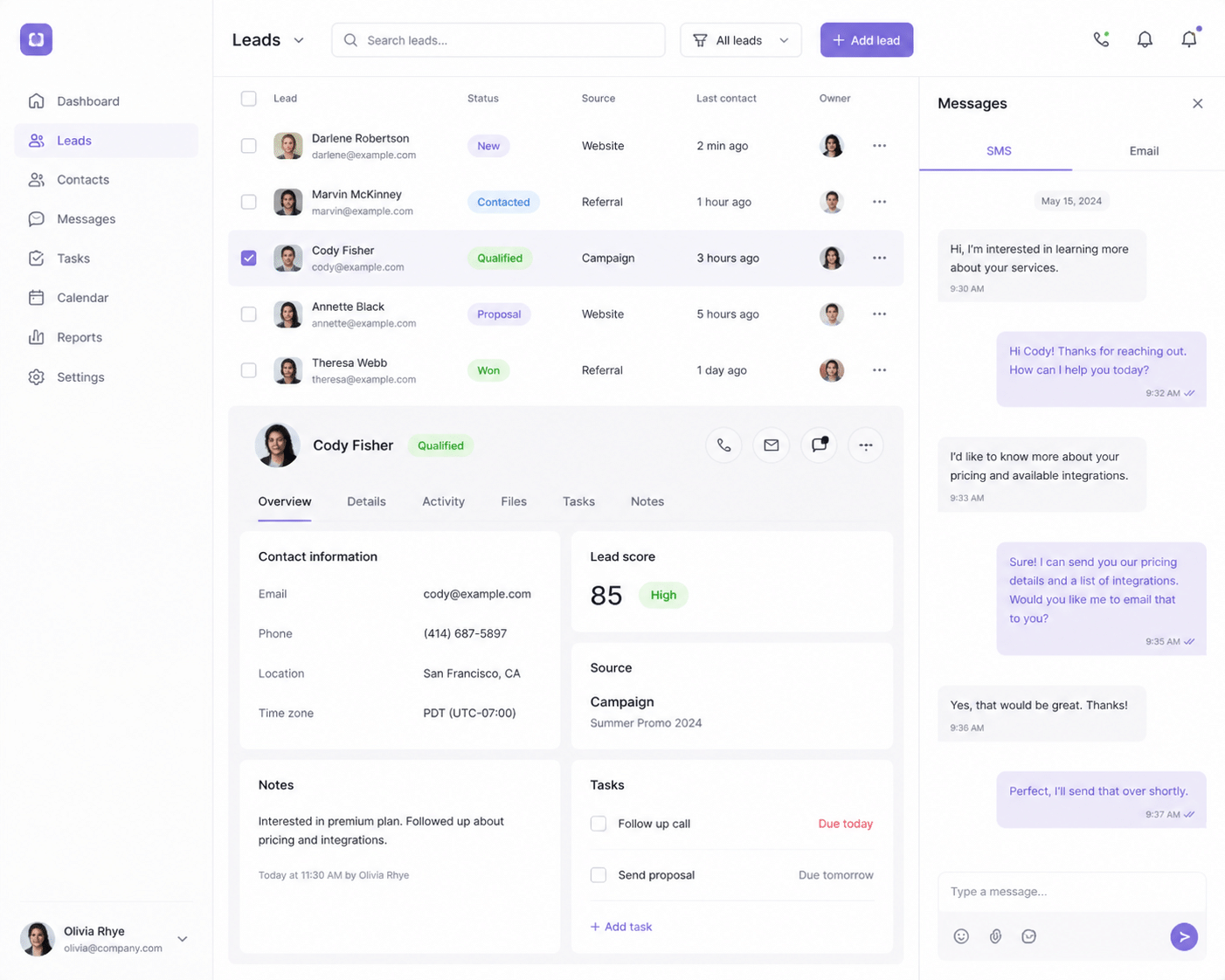
Let's clear something up first. An SMS CRM isn't just a fancy way to blast texts to a list of numbers. Not even close.
Think of it as one home for your leads and your text messages. The "CRM" part stores who the lead is, where they came from, what they asked for, and which stage they're in. The "SMS" part lets you message them right from that same record. One place. One story per customer.
Spreadsheet Plus Bulk SMS vs. a Real SMS CRM
Most small teams I talk to run things the patchwork way. Leads sit in Excel. Texts go out from a separate bulk SMS panel. Replies? Nobody's quite sure where those land. Honestly, it works until it doesn't.
A bulk SMS tool treats people as a list. A crm with sms integration treats them as leads moving toward a sale, with contact records, two-way messaging, automated workflows and reports all in one platform. Big difference.
Here's how the two setups stack up:
What you need | Spreadsheet + bulk SMS panel | Integrated SMS CRM |
|---|---|---|
Data visibility | Lead details in one file, messages in another panel | Lead details, source, notes and texts on one screen |
Replies | Often one-way, or lost on a personal phone | Two-way inbox tied to the lead |
Automation | Scheduled broadcasts only | Instant replies, lead assignment, reminders |
Follow-up tracking | Memory and sticky notes | Tasks and reminders on each lead |
Reporting | Delivery counts, maybe clicks | Response times, conversions, rep performance |
Team handover | Whoever has the file | Anyone with access sees the full history |
See the pattern? The left column is about sending. The right column is about selling.
It's the "Relationship" Part That Matters
Now picture a rep opening that Pune valve enquiry. In a basic setup, all he sees is a phone number and a name. Not much to work with.
In an SMS CRM, he sees the lead came from IndiaMart. He sees the product the buyer asked about, the notes from yesterday's call, and the text that went out two minutes after the enquiry arrived. He knows what's been said before he says a word.
That context changes the conversation. He doesn't ask "Who's this?" or repeat a pitch the buyer already heard. He picks up right where things left off. Buyers notice that. It feels like a company that has its act together, even if you're a team of five.
Plus, if that rep goes on leave tomorrow, nothing disappears. The history stays with the lead, not with a person's phone.
So that's the idea. Next, let's see what it actually does for your response speed.
Benefit #1: Achieve Unbeatable Speed-to-Lead and Instant Engagement
Let's go back to that Tuesday morning. The Pune buyer sent his enquiry at 11:40. What if he'd gotten a text from you at 11:40 and a few seconds?
That's the first big win of an SMS CRM. It answers the lead before your competitors have even seen the enquiry.
How the Instant Reply Actually Works
You set up a simple rule once. When a new lead lands from IndiaMart, TradeIndia, JustDial, a Google or Facebook ad, or your own website form, the CRM sends a personal text right away. No rep has to remember. No one has to be at their desk.
The lead is also saved, assigned and flagged for follow-up in the same moment. Here's the flow, step by step:
Step | What happens | Who does it |
|---|---|---|
1 | New lead arrives from IndiaMart (or any other source) | The buyer |
2 | CRM captures the lead and fills in name, number and product | The system |
3 | Automated welcome SMS goes out within seconds | The system |
4 | Sales rep gets an alert and calls the buyer | Your rep |
The nice part? Your rep still makes the human call. The text just buys him time and keeps the buyer warm. A good crm for IndiaMart leads should handle steps 1 to 3 without anyone touching a keyboard. Leadopal, for example, connects directly with IndiaMart, TradeIndia, JustDial, ad platforms and custom webhooks, so every source lands in one pipeline.
One small catch. In India, commercial texts need a registered sender ID and an approved template under TRAI's DLT rules. Your provider usually helps with this, and we'll cover it properly later.
A Template You Can Copy Today
Keep it short. Keep it human. Here's a simple one:
Hi [Lead Name], thanks for your inquiry on IndiaMart for [Product Name]. Our expert, [Sales Rep Name], will call you shortly. - [Your Company Name]
So the Pune buyer would see: "Hi Rakesh, thanks for your inquiry on IndiaMart for industrial valves. Our expert, Amit, will call you shortly. - Sharma Valves."
Three things make this work. It uses the buyer's name. It names a real person. And it tells him exactly what happens next. That's it.
Why Being First Matters So Much
Buyers on marketplaces rarely send one enquiry. They send five or ten, then wait to see who bothers to reply. You've probably done the same thing when shopping online.
You'll often see a claim that 78% of buyers choose the first vendor who responds. I'd be careful with that one, because a July 2026 review found it hard to trace back to a real primary study. A sturdier finding comes from Harvard Business Review and MIT research: contacting an inbound lead within one hour made companies nearly seven times more likely to qualify it.
So the exact number may be fuzzy. The direction isn't. Reply fast, and you're the vendor they remember. Reply late, and you're explaining why you took so long.
Next up: what happens after that first text, and how you keep the conversation going without chasing every lead by hand.
Benefit #2: Automate Sales Follow-ups and Nurture Leads at Scale
Here's a confession. Most lost leads aren't lost on day one. They slip away on day four, or day nine, when a busy rep simply forgets to call back.
That's the quiet leak in a lot of Indian MSMEs. And it's exactly what a text message CRM for small business is built to plug.
Why Leads Fall Through the Cracks
Think about your own team for a second. A rep gets 30 new enquiries in a week. Five are hot, ten are "maybe later," and the rest are junk. Who remembers to ping the "maybe later" group? Usually nobody.
The numbers back this up, kind of. One 2026 study on MSMEs using digital marketplaces found 32% of respondents worried about junk leads, and 41% struggled with platform analytics. I'd treat the exact figures with some care, since the sample may not represent every business. But the pain is real, and you've probably felt it.
Admin work makes it worse. Estimates vary, but one Forrester-based figure puts CRM data entry and pipeline updates at about 17% of a rep's week. That's roughly 6.8 hours that could go to actual selling.
Automated SMS follow-up takes the repetitive part off their plate. The system remembers. Your reps sell.
Set Up a Simple SMS Drip in 4 Steps
A drip campaign sounds fancy, but it's just a few short texts sent on a schedule. Not every lead is ready to buy today. Some need a week. Some need a month. A drip keeps you in their mind without a rep lifting a finger.
Here's a simple way to build one:
Step 1: Pick a trigger, like "new lead from IndiaMart" or "lead stage changed to Quote Sent."
Step 2: Add your first text right away (we covered that welcome message earlier).
Step 3: Add a wait of 2 or 3 days, then the next text.
Step 4: Add a stop rule, so the drip ends the moment the lead replies, buys or opts out.
That last step matters more than people think. Nobody likes getting "just checking in" after they've already said yes.
In a builder like Leadopal's drag-and-drop automation tool, the logic reads like plain English: if a new lead arrives from IndiaMart, then send SMS, wait 3 days, and if no reply, send the next one. No coding. No freelance developer.
As for timing, Verse.ai's 2026 nurture guidance suggests a rhythm like this: confirm fast, send something useful on day 2 or 3, check in around day 7, then re-engage near day 14. After that, go monthly.
Here's what that could look like for your valve business:
When | Sample text |
|---|---|
Day 0 | Hi Rakesh, thanks for your enquiry on valves. Amit from Sharma Valves will call you shortly. |
Day 3 | Hi Rakesh, did you get a chance to review our catalogue? Happy to share a quote for 500 units. |
Day 7 | Hi Rakesh, is this requirement still active? Reply YES and Amit will call today. |
Day 14 | Hi Rakesh, should we keep this open or reconnect next month? Reply LATER to pause. |
Keep each text to one purpose and one ask. Short wins.
One more thing. Don't overdo it. Roughly one or two texts a week during active follow-up is plenty, based on Salesmessage's follow-up guidance. More than that and you're the annoying vendor, not the helpful one.
Let Reminders Bring Your Reps Back In
Texts warm the lead up. But deals still close on calls.
So the smartest move is to end the drip with a human task. Say a lead gets three texts over a week. If they reply, the automation stops and the rep gets an alert. If they stay quiet, the CRM creates a "call this lead today" reminder on the rep's dashboard.
That's the safety net. No sticky notes, no "I thought you were calling him."
A good setup also handles the handover. The reminder lands on the right rep, with the full text history attached, so the call starts with context instead of guesswork.
This is the real value of lead management with SMS. Machines handle the patient, repetitive nudges. People handle the conversation that actually closes the deal.
But there's one more thing to sort out. When every rep is working leads this way, how do you see what's really going on across the whole team? That's next.
Benefit #3: Centralize Communication and Gain Full Visibility Over Your Sales Team
Here's a question. If your top rep quit tomorrow, what would you lose?
Not just a good salesperson. You'd lose every chat, every promise, every quote he sent from his own phone. That's the part nobody plans for.
Want to stop losing leads?
See how Lead Opal helps you capture, track, and follow up on every lead — automatically, across WhatsApp, Email & SMS.
The Personal WhatsApp Problem
Let's be honest about how most MSME sales teams work. Reps chat with buyers on their personal WhatsApp numbers. It's fast and it's familiar. I get why they do it.
But it's a mess for the business. The customer history lives on one phone. Managers can't see response times or what price was quoted. And the risks pile up: messages can be deleted, forwarded or lost with a phone. One Staffbase report even notes that US regulators have fined over 100 firms more than $2 billion since December 2021 for unarchived business messages on apps like WhatsApp. India's rules are different, sure. The lesson still travels: if you can't see the conversation, you can't control it.
Then there's the exit problem. Removing a rep from a CRM takes a minute. Getting customer chats back from his personal phone? Good luck.
One Dashboard, Every Message
An SMS CRM fixes this by moving the conversation onto a company-owned channel. Every text sent and every reply received gets logged automatically. And it's tied to the specific lead record, not floating in some shared folder.
So when your rep opens the Pune valve enquiry, he sees the full thread. The welcome text. The day 3 follow-up. The buyer's reply asking for a quote. All sitting under that one lead, next to the notes and the next task.
Here's what gets logged on each lead:
Every outgoing and incoming SMS, with date and time
The lead's source, like IndiaMart or a website form
Which rep owns the lead right now
Notes, tasks and reminders
Leadopal works this way too. Messages, lead details and rep activity sit in one pipeline, with role-based access so each person only sees the modules they need. And if you also chat on WhatsApp, its shared inbox brings those rep conversations under the same roof.
What Managers Actually Gain
OK, this is where it gets useful for the person running the team.
A manager can open any lead and read the conversation. No more asking "What did you tell him?" in the hallway. You can check that your brand sounds the same across all reps, spot a rude or sloppy reply early, and coach with real examples instead of guesses.
Reassigning gets easy too. Say a rep falls sick or leaves. You move his open leads to someone else in a few clicks, and the new rep sees the whole history. The buyer never notices a gap.
Here's how that changes day to day:
Situation | Personal phones | Central SMS CRM |
|---|---|---|
Rep goes on leave | Leads sit untouched | Reassign leads, history moves along |
Rep quits | Chats leave with him | Every message stays on the lead |
Manager wants to coach | Asks rep to show his phone | Reads the thread in the dashboard |
Message quality check | Impossible | Review any text, any time |
The End of "Who Spoke to Whom?"
Every sales team has had this argument. Rep A says he called the buyer last week. Rep B swears he never heard of it. The buyer got two quotes at two prices. Awkward.
A central log ends that. It becomes your single source of truth: who contacted the lead, when, what was said, and what happened next. No debate. Just a timeline.
And once everyone's working from the same record, you can finally see the bigger picture: which reps hit their targets and which leads are going stale. That ties neatly into keeping every message professional and compliant, which is where we're headed next.
Benefit #4: Ensure Professional, Compliant Messaging in India
Here's the part most people skip until it bites them. Sending texts in India isn't a free-for-all. There are rules, and a good SMS CRM keeps you on the right side of them.
I'll admit, regulation sounds boring. But a blocked message is a lost lead, so it's worth five minutes.
Staying on the Right Side of TRAI and DND
India's framework is called the Telecom Commercial Communications Customer Preference Regulations (TCCCPR), 2018. Businesses register on operator-run DLT platforms, get their sender names and message templates approved, and then send. According to TRAI's own guidance for senders, the registered entity ID, header and template ID travel with every message.
A proper bulk sms crm india platform handles that plumbing for you. It also keeps promotional texts away from numbers on the DND list, and it holds sends until the permitted window (roughly 10 a.m. to 9 p.m. IST for promotions). One rule matters more than people think: you can't label a sales offer as "transactional" just to get it through. That's the quickest way to get blocked.
Here's a quick cheat sheet.
SMS Compliance in India: Key Terms to Know (DND, TRAI, Sender ID)
Term | What it means in plain words |
|---|---|
TRAI | The telecom regulator that sets the rules for commercial texts |
DLT | The registry where you sign up your business, sender name and templates |
DND / NCPR | The list of people who've opted out of marketing texts |
Sender ID (header) | The six-character name shown instead of a phone number, like MYBIZ |
Template | Pre-approved message wording, with blanks for name, amount or date |
Promotional vs. transactional | Offers and marketing vs. order, payment and account updates |
Sender ID fees differ by operator and provider, so check current charges before you budget. Registration usually takes a few business days.
Why a Real Sender ID Beats a Random Number
Which would you open? A text from 98XXXXXX21, or one from something like LM-MYBIZ? Exactly.
A registered Sender ID shows your brand name right on the buyer's screen. It looks professional, and it tells the Pune valve buyer who's texting before he reads a word. I couldn't find a solid India-specific study proving a branded ID lifts open rates by some exact percentage, so I won't invent one. Still, recognition and trust are hard to argue with, especially for a small company trying to look established.
Templates: Same Message, Fewer Mistakes
Templates aren't just a compliance chore. They're a quiet time saver.
Take payment reminders. Without a template, one rep writes "Pls pay asap," another writes a polite paragraph, and a third forgets the invoice number. With a template, everyone sends the same clear message:
Dear [Name], your payment of Rs. [Amount] for invoice [Number] is due on [Date]. Please pay at [Link]. - [Your Company]
The same goes for order confirmations, quote follow-ups and delivery updates. You get a consistent tone, fewer typos and no wrong amounts. Plus, reps stop reinventing the same text ten times a day. Leadopal, for instance, keeps template management and DND-compliant segment management inside its SMS module, so campaigns stay tidy.
So your messages are fast, trackable and legal. But how do you pick a platform that actually delivers all this? That's next.
How to Choose the Right SMS CRM for Your MSME

Here's a mistake I see all the time. A business owner picks a tool because it looks great in a demo, then finds out three weeks later it can't pull in a single IndiaMart enquiry. Ouch.
So before you sign anything, use a checklist. It keeps you honest.
The 7 Features Worth Checking
The CRM world is crowded. Some tools are really bulk SMS senders wearing a CRM badge. Others are global suites built for a 500-person sales floor. Neither is ideal for a small Indian team. Here's what I'd look for instead:
# | Feature to look for | Why it matters for an MSME |
|---|---|---|
1 | Direct lead integrations (IndiaMart, TradeIndia, JustDial, Google and Facebook Ads, webhooks) | Leads land in one pipeline with no copy-pasting |
2 | Visual, drag-and-drop automation builder | You set up instant replies and follow-ups without a developer |
3 | SMS with DLT-friendly templates and DND-safe segments | Your texts actually get delivered |
4 | WhatsApp and SMS in one place (shared inbox) | Reps stop using personal phones |
5 | GST-compliant quotations and invoices | Quote, bill and collect without a separate tool |
6 | Role-based access and sales targets per rep | Owners see who's hitting numbers |
7 | One analytics dashboard | You see what's really driving sales |
Not every tool will tick all seven. That's OK. But the first three are close to non-negotiable if you live on marketplace leads.
Leadopal, for example, covers this whole list in a single platform, which is the kind of consolidation you want to compare against.
Price and Room to Grow
Now the money part. Global enterprise CRMs often price per user, then add modules, then add messaging fees. It adds up fast.
For a small Indian team, a realistic planning range is roughly ₹1,000 to ₹5,000 a month for software, plus message charges and GST. Entry-level multichannel plans in India are advertised from about ₹999 a month plus GST, though SMS and WhatsApp usage is billed separately. Pure SMS costs also vary. MSG91's India pricing starts around ₹0.25 per message at 5,000 messages and drops with volume. Prices change, so check the current rate card before you budget.
Ask these questions before buying:
Is pricing per user, per lead, or per message?
What happens when you add five more reps next year?
Do unused SMS credits expire?
Are DLT registration and sender ID charges included?
Can you export your data if you leave?
Scalability isn't about fancy features. It's about whether the bill stays sensible when your team doubles.
Look Closely at the Dashboard
This one gets skipped, and it shouldn't. Sending texts is easy. Knowing whether they made you money is the hard part.
A good unified dashboard shows how your SMS marketing CRM efforts connect to the pipeline. Which source brings the best leads? How fast does each rep respond? How many texts turned into calls, quotes and paid invoices? If SMS reports sit in one panel and sales numbers sit in another, you're back to guessing.
So ask for a live demo using your own lead flow, not a canned one. Connect an IndiaMart account, trigger a test enquiry, and watch what happens in the first minute. If the text goes out, the lead gets assigned and the dashboard updates, you've found a keeper.
Once you've picked your platform, the last step is putting all of this to work.
Conclusion: Stop Leaking Leads and Start Scaling Sales with SMS CRM
Go back to that Tuesday morning one last time. Same Pune buyer, same valve enquiry. But this time he gets a text in seconds, a rep gets an alert, and a reminder waits in the dashboard. Nothing gets lost.
That's the real shift. An SMS CRM isn't just another tool to log into. It moves your sales from "we'll get to it" to "it's already handled."
What You Get Back
Here's the short version of what we covered:
Faster conversions: Instant replies mean you're the vendor who answers first.
Better accountability: Every text, task and handover lives on the lead, not on a rep's personal phone.
A more professional look: Registered sender IDs and approved templates keep your messages clean and compliant.
Time back for selling: Automated follow-ups and reminders take the repetitive work off your reps.
And the payoff can come quickly. One sales-automation source says 76% of companies saw positive ROI within the first year. It's not an India-specific study, so treat it as a rough guide. Still, it points the right way.
Your Next Step
Look, spreadsheets got you this far. I get it. But every enquiry you pay for on IndiaMart deserves better than a forgotten cell and a sticky note.
So here's my ask. Pick one lead source this week. Connect it to an integrated platform, switch on an instant reply, and watch what happens in the first minute. That's how you build a sales process that scales through 2026 and beyond.
Ready to Automate Your Sales? See Leadopal's SMS CRM in Action
Stop leaking leads. Start closing them.